Tuesday, January 25, 2011

A Cup of "Perfect Peach" Tea

This is a lovely tea--very fragrant. Everyone in my house THINKS she wants a taste, but I'm alone for actually liking it.

Here's some of tonight's commentary from Alice (3):

Al:  Mom, can I taste your tea?
me: Sure.
Al:  Mmm. It tastes like gum--like CHEWED gum. 
me: Really? 
Al:  Do YOU think it tastes like chewed gum?
me: I don't know. I've never tasted chewed gum. 
Al:  Hm. It tastes like chewed gum. 

She sort of has a point, but how does she know the taste of chewed gum?

(btw: she looked exactly like Jenni Mella--including facial expressions and shoulder shrugs--as we had this conversation. Amazing!)

Monday, January 24, 2011

"Mom, is Dad a nerd?"

Here's a fun conversation I had tonight with Eden (6) : 
eden: Mom, is Dad a nerd? 
me: Yes. Dad likes to be a nerd.
eden: How do you get to be a nerd?
me: You just study hard, you get good at math, and then you're a nerd.
eden: I mean, does someone have to say that you're a nerd--like the mayor or someone like that?
me: No, you just declare yourself a nerd.
I'm not good at math, but I like to think that my closet love of the original Star Trek gives me some rights to nerdhood.
Catch an old episode here.


Live long and prosper!

Thursday, January 20, 2011

Cooking with My Grandmothers

My microwave died a couple of weeks ago. Quite suddenly. No heaving out its last breath for a few days. One minute it worked; the next minute, I needed a new one.

But, I was sick--really sick--and these things take a bit of research. It needs to fit a very specific, small hole in the cupboards. It took a while before I even felt like looking, then another while to decide which one to buy.

In the meantime, I got to ask myself, "How on earth do I melt the butter for popcorn? Are you kidding me--a saucepan? Frozen edamame beans that Alice insists on daily--no! Another pan! . . . I need a quick roux (flour mixed in melted butter) to add to the potato soup? Another pan just to mix the roux?!

It was seriously irritating. I ignored all leftovers.

Then one afternoon, I really wanted to reheat some mashed potatoes, and it dawned on me that my grandmothers knew how to manage leftovers without a microwave. I asked, "How did Grandma Nonie reheat mashed potatoes?" And, then, without ceremony or any visible indicator, my kitchen transformed into a holy intersection between heaven and earth:

"So simple. Just put a little milk in the pan, get it hot, add the potatoes, and stir really fast before it burns."

It worked perfectly. "Wow, thanks, Grandma. What about the gravy? Dinner rolls? Bacon is so messy! What do I do with these extra dirty pans?"

"So, easy! Just a little extra scrubbing or soak it while you clean up." 

So fun to hang out in the kitchen with my grandmothers this week. Whether my DNA retains their memories, or my grandmothers are actually more available than I thought, it was a party with the grandmas every night in my kitchen.

My new microwave arrived today. It's stainless steel and very sleek. Works great.

Not as fun as hanging with my grandmas. I'm going miss them. 

Saturday, January 1, 2011

Happy New Year!

You may have noticed, I haven't been a stellar blogger this year. My resolution for 2011 is to post once a month! I'm really shooting for once a week but don't want to risk overpromising. So here's my first post and New Year wish to you: 


 Hope springs eternal! Here's to looking forward in 2011.

Tuesday, July 27, 2010

Who gets sick in the summer? OR . . . happy birthday, Sarah. . .

. . . from my flu bed. Enjoy the swimming.

I actually sent David and the peeps down to his sister’s tonight for Sarah’s 15th birthday, so I could lay in bed, moaning.

Nancy informed me that missing your daughter’s birthday party is inappropriate behavior for a mother, but the swimming was planned yesterday, and I can’t exactly waltz in with my flu. So, here’s my attempt to make it up.

[btw: chances of my children reading this are, exactly, zero. That would be the equivalent of volunteering for a lecture.]

So, here’s my girl.

I like this picture, because you can see that there’s a lot more going on than her pretty face. This girl is complicated. Her fourth grade teacher tipped us off to this complexity during our first parent-teacher conference: “All these kids are 4th graders, and then there’s Sarah over there bantering with this dry wit that no other 4th grader even gets.” Then he raved about her artwork and advanced essay writing.

Do I sound like her mother, or what?!

David and I left that conference soaring like the parenting gods had smiled down on us and hoping that we hadn’t used up all our good-kid-tickets. (Those conferences don’t always go so well.)

This is exactly the look she had once when I was ranting about something and slipped out a “dadgummit.”  She held that look without cracking a smile and asked, “Is ‘dadgummit’ a compound word?”  (That was 5th grade.)

Which brings me to another interesting tidbit about her . . . She never dominates a conversation but can strangely control the direction it takes—unusual diplomacy for a 15 year old.  She’s obscenely helpful with the little girls and is the only one in the family who can do hair. (Heaven help us when she leaves for college.)

This pict shows her more playful side. She has these amazing eyebrows that can dance around independent of one another and everything else. Eat your heart out, Sherlock Holmes.

So there you have it: happy birthday, Sarah. I can’t believe you’re 15, and I can’t believe you’re only 15!

You’re amazing, and we love you.

Love,
Mom & Dad

Saturday, July 24, 2010

How the stoner in Mr. Dant's class shamed the Mormons

I just remembered something that happened in my sophomore English class. It was an honors class, so there were a bunch of smart kids. We were a pretty homogeneous-looking group, wearing a lot of retro-preppy 80s clothes. (This thrilled my parents to no end.)

The class was, I'd guess, half Mormon. One kid there (maybe there were others) didn't fit; he wore a black concert T-shirt everyday: AC/DC, Iron Maiden, Bon Jovi, maybe KISS. Very un-retro-preppy.
He also had long hair—very definitely NOT retro-preppy. Boys didn't have long hair in the 80s unless they were stoned. He didn't comment much, but Mr. Dant must have seen potential there, because occasionally he'd call on him directly, and Concert T would reply with something very snarky and we'd all go, "Whoa, he's smart for a stoner."

But, that's all background. Here's the real story: We were discussing I don't know what, when the conversation turned to religion. Mr. Dant asked: "Why do people go to church?" The Mormons perked up, smelling a "missionary moment."

Mr. Dant called on one of us. I can't remember who, but the answer was, roughly: "We go to church to learn about God and the scriptures."

Mr. Dant looked confused, "Nope."

Small panic. That was my answer. What was the question?

He asked another student who gave a variation on the same answer, "To learn what God wants us to do," then someone else, " . . . to learn what we have to do to get back into heaven." We kept going like this.

Mr. Dant kept shaking his head saying, "No, no, no!" and laughing. I was wracking my brains. What could he possibly be looking for? Then, he called on Concert T who didn’t hesitate: "To worship God," he said.

Oh.

Yeah. Right. That's it. Why didn't we think of that?

I swear I could read Mr. Dant's mind: What a bunch of sorry Mormon kids who don't even know why they go to church! Now I'm wondering if my kids would say anything different. I’m also wondering if I really know what it means to worship. I confess, I only use that term when I'm describing an unhealthy romantic relationship.

[I’m stretching for a working definition here. Can anyone help?

How about: to express love and adoration, acknowledging the perfection and wisdom of the worshipped, with a commitment to follow absolutely. That’s a little frightening, isn’t it?]

Even now, church is a lot of corralling my offspring, doing my duty, still trying to learn, and refilling my own cup—not so much worship.

I do worship, but I think it mostly happens in odd settings, like driving on the freeway or folding laundry when my mind has time to wander, uninterrupted. Sometimes it wanders into gratitude which leads me to worship. Only sometimes.

I don’t worship enough. I wish I could remember Concert T’s name. I’d like to ask him about his worship. I should have asked him when I had the chance. 

Does anyone have a picture of Mr. Dant or Concert T?

Sunday, July 4, 2010

Documents of Freedom Week: Day 7 (July 3)

VIRGINIA DECLARATION OF RIGHTS—May 15, 1776:
“All men are by nature equally free and independent.”

Quick reality check—how long has it been since we expected “moderation, temperance, frugality and virtue” out of our government?  Look at Section 15—“That no free government, or the blessings of liberty, can be preserved to any people, but by a firm adherence to justice, moderation, temperance, frugality, and virtue, and by frequent recurrence to fundamental principles.

What would he say to us now?


Principal author of the Declaration of Rights: George Mason—“The wisest man of his generation” (Thomas Jefferson)
 

On May 15, 1776, the Virginia Convention "resolved unanimously that the delegates appointed to represent this colony in General Congress be instructed to propose to that respectable body to declare the United Colonies free and independent states . . . [and] that a committee be appointed to prepare a DECLARATION OF RIGHTS and . . . plan of government."  As passed, the Virginia Declaration was largely the work of George Mason; this declaration served as a model for bills of rights in several other state constitutions.


Virginia Declaration of Rights

A declaration of rights made by the representatives of the good people of Virginia, assembled in full and free convention; which rights do pertain to them and their posterity, as the basis and foundation of government.

SECTION I. That all men are by nature equally free and independent and have certain inherent rights, of which, when they enter into a state of society, they cannot, by any compact, deprive or divest their posterity; namely, the enjoyment of life and liberty, with the means of acquiring and possessing property, and pursuing and obtaining happiness and safety.

SEC. 2. That all power is vested in, and consequently derived from, the people; that magistrates are their trustees and servants and at all times amenable to them.

SEC. 3. That government is, or ought to be, instituted for the common benefit, protection, and security of the people, nation, or community; of all the various modes and forms of government, that is best which is capable of producing the greatest degree of happiness and safety and is most effectually secured against the danger of maladministration; and that, when any government shall be found inadequate or contrary to these purposes, a majority of the community hath an indubitable, inalienable, and indefeasible right to reform, alter, or abolish it, in such manner as shall be judged most conducive to the public weal.

SEC. 4. That no man, or set of men, are entitled to exclusive or separate emoluments or privileges from the community, but in consideration of public services; which, not being descendible, neither ought the offices of magistrate, legislator, or judge to be hereditary.

SEC. 5. That the legislative and executive powers of the state should be separate and distinct from the judiciary; and that the members of the two first may be restrained from oppression, by feeling and participating the burdens of the people, they should, at fixed periods, be reduced to a private station, return into that body from which they were originally taken, and the vacancies be supplied by frequent, certain, and regular elections, in which all, or any part, of the former members, to be again eligible, or ineligible, as the laws shall direct.

SEC. 6. That elections of members to serve as representatives of the people, in assembly, ought to be free; and that all men, having sufficient evidence of permanent common interest with, and attachment to, the community, have the right of suffrage and cannot be taxed or deprived of their property for public uses without their own consent, or that of their representatives so elected, nor bound by any law to which they have not, in like manner, assented for the public good. [Term limits!]

SEC. 7. That all power of suspending laws, or the execution of laws, by any authority, without consent of the representatives of the people, is injurious to their rights and ought not to be exercised.

SEC. 8. That in all capital or criminal prosecutions a man hath a right to demand the cause and nature of his accusation, to be confronted with the accusers and witnesses, to call for evidence in his favor, and to a speedy trial by an impartial jury of twelve men of his vicinage, without whose unanimous consent he cannot be found guilty; nor can he be compelled to give evidence against himself; that no man be deprived of his liberty, except by the law of the land or the judgment of his peers.

SEC. 9. That excessive bail ought not to be required, nor excessive fines imposed, nor cruel and unusual punishments inflicted.

SEC. 10. That general warrants, whereby an officer or messenger may be commanded to search suspected places without evidence of a fact committed, or to seize any person or persons not named, or whose offense is not particularly described and supported by evidence, are grievous and oppressive and ought not to be granted.

SEC. 11. That in controversies respecting property, and in suits between man and man, the ancient trial by jury is preferable to any other and ought to be held sacred.

SEC. 12. That the freedom of the press is one of the great bulwarks of liberty and can never be restrained but by despotic governments.

SEC. 13. That a well-regulated militia, or composed of the body of the people, trained to arms, is the proper, natural, and safe defense of a free state; that standing armies, in time of peace, should be avoided as dangerous to liberty; and that in all cases the military should be under strict subordination to, and governed by, the civil power.

SEC. 14. That the people have a right to uniform government; and, therefore, that no government separate from or independent of the government of Virginia ought to be erected or established within the limits thereof.

SEC. 15. That no free government, or the blessings of liberty, can be preserved to any people, but by a firm adherence to justice, moderation, temperance, frugality, and virtue, and by frequent recurrence to fundamental principles.

SEC. 16. That religion, or the duty which we owe to our Creator, and the manner of discharging it, can be directed only by reason and conviction, not by force or violence; and therefore all men are equally entitled to the free exercise of religion, according to the dictates of conscience; and that it is the mutual duty of all to practice Christian forbearance, love, and charity toward each other.

1. The Federal and State Constitutions, Colonial Charters . . . , ed. F. N. Thorpe (Washington, 1909), VII, 3812-14

Documents of Freedom Week: Day 8 (July 4)

“To secure these rights, Governments are instituted among Men.”

IN CONGRESS, JULY 4, 1776
The unanimous Declaration of the thirteen united States of America

This is awesome! And only 9 minutes long. Thank you, Hollywood (rare words at our house). Here’s a longer version of the same thing, but with introduction by Morgan Freeman: http://www.youtube.com/watch?v=jYyttEu_NLU&feature=related 

Enjoy!

When in the Course of human events it becomes necessary for one people to dissolve the political bands which have connected them with another and to assume among the powers of the earth, the separate and equal station to which the Laws of Nature and of Nature's God entitle them, a decent respect to the opinions of mankind requires that they should declare the causes which impel them to the separation.

We hold these truths to be self-evident, that all men are created equal, that they are endowed by their Creator with certain unalienable Rights, that among these are Life, Liberty and the pursuit of Happiness. — That to secure these rights, Governments are instituted among Men, deriving their just powers from the consent of the governed, — That whenever any Form of Government becomes destructive of these ends, it is the Right of the People to alter or to abolish it, and to institute new Government, laying its foundation on such principles and organizing its powers in such form, as to them shall seem most likely to effect their Safety and Happiness.

Prudence, indeed, will dictate that Governments long established should not be changed for light and transient causes; and accordingly all experience hath shewn that mankind are more disposed to suffer, while evils are sufferable than to right themselves by abolishing the forms to which they are accustomed. But when a long train of abuses and usurpations, pursuing invariably the same Object evinces a design to reduce them under absolute Despotism, it is their right, it is their duty, to throw off such Government, and to provide new Guards for their future security. — Such has been the patient sufferance of these Colonies; and such is now the necessity which constrains them to alter their former Systems of Government. The history of the present King of Great Britain is a history of repeated injuries and usurpations, all having in direct object the establishment of an absolute Tyranny over these States. To prove this, let Facts be submitted to a candid world.

He has refused his Assent to Laws, the most wholesome and necessary for the public good.

He has forbidden his Governors to pass Laws of immediate and pressing importance, unless suspended in their operation till his Assent should be obtained; and when so suspended, he has utterly neglected to attend to them.

He has refused to pass other Laws for the accommodation of large districts of people, unless those people would relinquish the right of Representation in the Legislature, a right inestimable to them and formidable to tyrants only.

He has called together legislative bodies at places unusual, uncomfortable, and distant from the depository of their Public Records, for the sole purpose of fatiguing them into compliance with his measures.

He has dissolved Representative Houses repeatedly, for opposing with manly firmness his invasions on the rights of the people.

He has refused for a long time, after such dissolutions, to cause others to be elected, whereby the Legislative Powers, incapable of Annihilation, have returned to the People at large for their exercise; the State remaining in the mean time exposed to all the dangers of invasion from without, and convulsions within.

He has endeavoured to prevent the population of these States; for that purpose obstructing the Laws for Naturalization of Foreigners; refusing to pass others to encourage their migrations hither, and raising the conditions of new Appropriations of Lands.

He has obstructed the Administration of Justice by refusing his Assent to Laws for establishing Judiciary Powers.

He has made Judges dependent on his Will alone for the tenure of their offices, and the amount and payment of their salaries.

He has erected a multitude of New Offices, and sent hither swarms of Officers to harass our people and eat out their substance.

He has kept among us, in times of peace, Standing Armies without the Consent of our legislatures.

He has affected to render the Military independent of and superior to the Civil Power.

He has combined with others to subject us to a jurisdiction foreign to our constitution, and unacknowledged by our laws; giving his Assent to their Acts of pretended Legislation:

For quartering large bodies of armed troops among us:
For protecting them, by a mock Trial from punishment for any Murders which they should commit on the Inhabitants of these States:
For cutting off our Trade with all parts of the world:
For imposing Taxes on us without our Consent:
For depriving us in many cases, of the benefit of Trial by Jury:
For transporting us beyond Seas to be tried for pretended offences:
For abolishing the free System of English Laws in a neighbouring Province, establishing therein an Arbitrary government, and enlarging its Boundaries so as to render it at once an example and fit instrument for introducing the same absolute rule into these Colonies
For taking away our Charters, abolishing our most valuable Laws and altering fundamentally the Forms of our Governments:
For suspending our own Legislatures, and declaring themselves invested with power to legislate for us in all cases whatsoever.

He has abdicated Government here, by declaring us out of his Protection and waging War against us.

He has plundered our seas, ravaged our coasts, burnt our towns, and destroyed the lives of our people.

He is at this time transporting large Armies of foreign Mercenaries to compleat the works of death, desolation, and tyranny, already begun with circumstances of Cruelty & Perfidy scarcely paralleled in the most barbarous ages, and totally unworthy the Head of a civilized nation.

He has constrained our fellow Citizens taken Captive on the high Seas to bear Arms against their Country, to become the executioners of their friends and Brethren, or to fall themselves by their Hands.

He has excited domestic insurrections amongst us, and has endeavoured to bring on the inhabitants of our frontiers, the merciless Indian Savages whose known rule of warfare, is an undistinguished destruction of all ages, sexes and conditions.

In every stage of these Oppressions We have Petitioned for Redress in the most humble terms: Our repeated Petitions have been answered only by repeated injury. A Prince, whose character is thus marked by every act which may define a Tyrant, is unfit to be the ruler of a free people.

Nor have We been wanting in attentions to our British brethren. We have warned them from time to time of attempts by their legislature to extend an unwarrantable jurisdiction over us. We have reminded them of the circumstances of our emigration and settlement here. We have appealed to their native justice and magnanimity, and we have conjured them by the ties of our common kindred to disavow these usurpations, which would inevitably interrupt our connections and correspondence. They too have been deaf to the voice of justice and of consanguinity. We must, therefore, acquiesce in the necessity, which denounces our Separation, and hold them, as we hold the rest of mankind, Enemies in War, in Peace Friends.

We, therefore, the Representatives of the united States of America, in General Congress, Assembled, appealing to the Supreme Judge of the world for the rectitude of our intentions, do, in the Name, and by Authority of the good People of these Colonies, solemnly publish and declare, That these united Colonies are, and of Right ought to be Free and Independent States, that they are Absolved from all Allegiance to the British Crown, and that all political connection between them and the State of Great Britain, is and ought to be totally dissolved; and that as Free and Independent States, they have full Power to levy War, conclude Peace, contract Alliances, establish Commerce, and to do all other Acts and Things which Independent States may of right do. — And for the support of this Declaration, with a firm reliance on the protection of Divine Providence, we mutually pledge to each other our Lives, our Fortunes, and our sacred Honor.

John Hancock

New Hampshire:
Josiah Bartlett, William Whipple, Matthew Thornton

Massachusetts:
John Hancock, Samuel Adams, John Adams, Robert Treat Paine, Elbridge Gerry

Rhode Island:
Stephen Hopkins, William Ellery

Connecticut:
Roger Sherman, Samuel Huntington, William Williams, Oliver Wolcott

New York:
William Floyd, Philip Livingston, Francis Lewis, Lewis Morris

New Jersey:
Richard Stockton, John Witherspoon, Francis Hopkinson, John Hart, Abraham Clark

Pennsylvania:
Robert Morris, Benjamin Rush, Benjamin Franklin, John Morton, George Clymer, James Smith, George Taylor, James Wilson, George Ross

Delaware:
Caesar Rodney, George Read, Thomas McKean

Maryland:
Samuel Chase, William Paca, Thomas Stone, Charles Carroll of Carrollton

Virginia:
George Wythe, Richard Henry Lee, Thomas Jefferson, Benjamin Harrison, Thomas Nelson, Jr., Francis Lightfoot Lee, Carter Braxton

North Carolina:
William Hooper, Joseph Hewes, John Penn

South Carolina:
Edward Rutledge, Thomas Heyward, Jr., Thomas Lynch, Jr., Arthur Middleton

Georgia:
Button Gwinnett, Lyman Hall, George Walton

Declaration text | Rough Draft | Congress's Draft | Compare | Dunlap Broadside | Image | Scan

Saturday, July 3, 2010

Documents of Freedom Week: Day 6

MARCH 31, 1776, ABIGAIL ADAMS TO JOHN ADAMS: “We are determined to foment a rebellion.”

Thank you, Abigail, for this lovely missive. What would American History be without all your beautiful words: “I desire you would remember the ladies and be more generous and favorable to them than your ancestors.”
"I long to hear that you have declared an independency. And, by the way, in the new code of laws which I suppose it will be necessary for you to make, I desire you would remember the ladies and be more generous and favorable to them than your ancestors.

"Do not put such unlimited power into the hands of the husbands.

"Remember, all men would be tyrants if they could. If particular care and attention is not paid to the ladies, we are determined to foment a rebellion, and will not hold ourselves bound by any laws in which we have no voice or representation.

"That your sex are naturally tyrannical is a truth so thoroughly established as to admit of no dispute; but such of you as wish to be happy willingly give up -- the harsh tide of master for the more tender and endearing one of friend.

"Why, then, not put it out of the power of the vicious and the lawless to use us with cruelty and indignity with impunity?

"Men of sense in all ages abhor those customs which treat us only as the (servants) of your sex; regard us then as being placed by Providence under your protection, and in imitation of the Supreme Being make use of that power only for our happiness."

Documents of Freedom Week: Day 5

Patrick Henry, March 23, 1775: “Give Me Liberty Or Give Me Death”

“Let us not, I beseech you, sir, deceive ourselves. . .there is no longer any room for hope.”

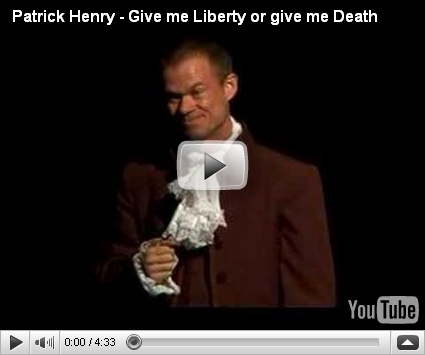
There’s so much more to this speech than that inflammatory  last line. Here’s a partial performance by a good actor. I <3 PH.

(See below for full text renderings.)

FULL TEXT:
No man thinks more highly than I do of the patriotism, as well as abilities, of the very worthy gentlemen who have just addressed the House. But different men often see the same subject in different lights; and, therefore, I hope it will not be thought disrespectful to those gentlemen if, entertaining as I do opinions of a character very opposite to theirs, I shall speak forth my sentiments freely and without reserve. This is no time for ceremony. The questing before the House is one of awful moment to this country. For my own part, I consider it as nothing less than a question of freedom or slavery; and in proportion to the magnitude of the subject ought to be the freedom of the debate. It is only in this way that we can hope to arrive at truth, and fulfill the great responsibility which we hold to God and our country. Should I keep back my opinions at such a time, through fear of giving offense, I should consider myself as guilty of treason towards my country, and of an act of disloyalty toward the Majesty of Heaven, which I revere above all earthly kings.

Mr. President, it is natural to man to indulge in the illusions of hope. We are apt to shut our eyes against a painful truth, and listen to the song of that siren till she transforms us into beasts. Is this the part of wise men, engaged in a great and arduous struggle for liberty? Are we disposed to be of the number of those who, having eyes, see not, and, having ears, hear not, the things which so nearly concern their temporal salvation? For my part, whatever anguish of spirit it may cost, I am willing to know the whole truth; to know the worst, and to provide for it.

I have but one lamp by which my feet are guided, and that is the lamp of experience. I know of no way of judging of the future but by the past. And judging by the past, I wish to know what there has been in the conduct of the British ministry for the last ten years to justify those hopes with which gentlemen have been pleased to solace themselves and the House. Is it that insidious smile with which our petition has been lately received? Trust it not, sir; it will prove a snare to your feet. Suffer not yourselves to be betrayed with a kiss. Ask yourselves how this gracious reception of our petition comports with those warlike preparations which cover our waters and darken our land. Are fleets and armies necessary to a work of love and reconciliation? Have we shown ourselves so unwilling to be reconciled that force must be called in to win back our love? Let us not deceive ourselves, sir. These are the implements of war and subjugation; the last arguments to which kings resort.

I ask gentlemen, sir, what means this martial array, if its purpose be not to force us to submission? Can gentlemen assign any other possible motive for it? Has Great Britain any enemy, in this quarter of the world, to call for all this accumulation of navies and armies? No, sir, she has none. They are meant for us: they can be meant for no other. They are sent over to bind and rivet upon us those chains which the British ministry have been so long forging. And what have we to oppose to them? Shall we try argument? Sir, we have been trying that for the last ten years. Have we anything new to offer upon the subject? Nothing. We have held the subject up in every light of which it is capable; but it has been all in vain. Shall we resort to entreaty and humble supplication? What terms shall we find which have not been already exhausted? Let us not, I beseech you, sir, deceive ourselves. Sir, we have done everything that could be done to avert the storm which is now coming on. We have petitioned; we have remonstrated; we have supplicated; we have prostrated ourselves before the throne, and have implored its interposition to arrest the tyrannical hands of the ministry and Parliament. Our petitions have been slighted; our remonstrances have produced additional violence and insult; our supplications have been disregarded; and we have been spurned, with contempt, from the foot of the throne! In vain, after these things, may we indulge the fond hope of peace and reconciliation. There is no longer any room for hope. If we wish to be free-- if we mean to preserve inviolate those inestimable privileges for which we have been so long contending--if we mean not basely to abandon the noble struggle in which we have been so long engaged, and which we have pledged ourselves never to abandon until the glorious object of our contest shall be obtained--we must fight! I repeat it, sir, we must fight! An appeal to arms and to the God of hosts is all that is left us!

They tell us, sir, that we are weak; unable to cope with so formidable an adversary. But when shall we be stronger? Will it be the next week, or the next year? Will it be when we are totally disarmed, and when a British guard shall be stationed in every house? Shall we gather strength by irresolution and inaction? Shall we acquire the means of effectual resistance by lying supinely on our backs and hugging the delusive phantom of hope, until our enemies shall have bound us hand and foot? Sir, we are not weak if we make a proper use of those means which the God of nature hath placed in our power. The millions of people, armed in the holy cause of liberty, and in such a country as that which we possess, are invincible by any force which our enemy can send against us. Besides, sir, we shall not fight our battles alone. There is a just God who presides over the destinies of nations, and who will raise up friends to fight our battles for us. The battle, sir, is not to the strong alone; it is to the vigilant, the active, the brave. Besides, sir, we have no election. If we were base enough to desire it, it is now too late to retire from the contest. There is no retreat but in submission and slavery! Our chains are forged! Their clanking may be heard on the plains of Boston! The war is inevitable--and let it come! I repeat it, sir, let it come.

It is in vain, sir, to extenuate the matter. Gentlemen may cry, Peace, Peace-- but there is no peace. The war is actually begun! The next gale that sweeps from the north will bring to our ears the clash of resounding arms! Our brethren are already in the field! Why stand we here idle? What is it that gentlemen wish? What would they have? Is life so dear, or peace so sweet, as to be purchased at the price of chains and slavery? Forbid it, Almighty God! I know not what course others may take; but as for me, give me liberty or give me death!

Watch here:

Good audio, no video: http://www.youtube.com/watch?v=_7FbAU-caVg&feature=related
Good performance, partial text:  http://www.youtube.com/watch?v=iEOets_L7vg
Whole text (bad video) http://www.youtube.com/watch?v=IbOGo_T01bo&feature=related
Great teacher standing