Saturday, July 3, 2010

Documents of Freedom Week: Day 4

THE DECLARATION OF RIGHTS—OCTOBER 19, 17651, the Stamp Act Congress: “It is inseparably essential to the freedom of a people, and the undoubted rights of Englishmen, that no taxes should be imposed on them, but with their own consent, given personally, or by their representatives.”

Old City Hall, New York City


On the motion of James Otis, on June 8, the Massachusetts legislature sent a circular inviting all the colonies to send delegates to a congress at New York in October, 1765. Representatives from only nine colonies appeared. Virginia, New Hampshire, North Carolina, and Georgia were not represented. The Congress agreed upon the Declaration of Rights reproduced here and, further, petitioned the king and Parliament. Because the credentials of certain delegates authorized them merely to consult and not to take action, the petition was signed by the members of only six colonies.

Saturday, Oct. 19th, 1765, A.M. -- The congress met according to adjournment, and resumed, etc., as yesterday; and upon mature deliberation, agreed to the following declaration of the rights and grievances of the colonists in America, which were ordered to be inserted.

DECLARATION OF RIGHTS

The members of this congress, sincerely devoted, with the warmest sentiments of affection and duty to His Majesty's person and government, inviolably attached to the present happy establishment of the Protestant succession, and with minds deeply impressed by a sense of the present and impending misfortunes of the British colonies on this continent; having considered as maturely as time would permit, the circumstances of said colonies, esteem it our indispensable duty to make the following declarations, of our humble opinions, respecting the most essential rights and liberties of the colonists, and of the grievances under which they labor, by reason of several late acts of Parliament.

1st. That His Majesty's subjects in these colonies owe the same allegiance to the crown of Great Britain that is owing from his subjects born within the realm, and all due subordination to that august body, the Parliament of Great Britain.

2d. That His Majesty's liege subjects in these colonies are entitled to all the inherent rights and privileges of his natural born subjects within the kingdom of Great Britain.

3d. That it is inseparably essential to the freedom of a people, and the undoubted rights of Englishmen, that no taxes should be imposed on them, but with their own consent, given personally, or by their representatives.

4th. That the people of these colonies are not, and from their local circumstances cannot be, represented in the House of Commons in Great Britain.

5th. That the only representatives of the people of these colonies are persons chosen therein, by themselves; and that no taxes ever have been or can be constitutionally imposed on them but by their respective legislatures.

6th. That all supplies to the crown, being free gifts of the people, it is unreasonable and inconsistent with the principles and spirit of the British constitution for the people of Great Britain to grant to His Majesty the property of the colonists.

7th. That trial by jury is the inherent and invaluable right of every British subject in these colonies.

8th. That the late act of Parliament entitled, "An act for granting and applying certain stamp duties, and other duties in the British colonies and plantations in America, etc.," by imposing taxes on the inhabitants of these colonies, and the said act, and several other acts, by extending the jurisdiction of the courts of admiralty beyond its ancient limits, have a manifest tendency to subvert the rights and liberties of the colonists.

9th. That the duties imposed by several late acts of Parliament, from the peculiar circumstances of these colonies, will be extremely burthensome and grievous, and, from the scarcity of specie, the payment of them absolutely impracticable.

10th. That as the profits of the trade of these colonies ultimately center in Great Britain, to pay for the manufactures which they are obliged to take from thence, they eventually contribute very largely to all supplies granted there to the crown.

11th. That the restrictions imposed by several late acts of Parliament on the trade of these colonies will render them unable to purchase the manufactures of Great Britain.

12th. That the increase, prosperity, and happiness of these colonies depend on the full and free enjoyment of their rights and liberties, and an intercourse, with Great Britain, mutually affectionate and advantageous.

13th. That it is the right of the British subjects in these colonies to petition the king or either house of Parliament.

Lastly, That it is the indispensable duty of these colonies to the best of sovereigns, to the mother-country, and to themselves, to endeavor, by a loyal and dutiful address to His Majesty, and humble application to both houses of Parliament, to procure the repeal of the act for granting and applying certain stamp duties, of all clauses of any other acts of Parliament whereby the jurisdiction of the admiralty is extended as aforesaid, and of the other late acts for the restriction of the American commerce.


1. Journal of the First Congress of the American Colonies, in Opposition to the Tyrannical Acts of the British Parliament. Held at New York, October 7, 1765 (New York, 1845), pp. 27-29.

Documents of Freedom Week: Day 3

Albany Plan of Union (1754) by Benjamin Franklin


It turns out, Benjamin Franklin really was one of the smart ones. This is one of those docs that slipped my notice, and the first time I read through it (just a few years ago), I was blown away by Franklin’s forethought.
Here’s some background (mostly from wikipedia):

In the early 1750s, rivalry between England and France over who would control the North American continent led to what is known as the French and Indian Wars. This conflict lasted from 1756 to 1763, and left England the dominant power in the area that now comprises the eastern United States and Canada.

Aware of the strains that war would put on the colonies, English officials suggested a "union between ye Royal, Proprietary & Charter Governments."1 At least some colonial leaders were thinking along the same lines. In June 1754 delegates from most of the northern colonies and representatives from the Six Iroquois Nations met in Albany, New York. There they adopted a "plan of union" drafted by Benjamin Franklin of Pennsylvania. Under this plan each colonial legislature would elect delegates to an American continental assembly presided over by a royal governor.

The plan is noteworthy in several respects. First of all, Franklin anticipated many of the problems that would beset the government created after independence, such as finance, dealing with the Indian tribes, control of commerce, and defense. In fact, it contains the seeds of true union, and many of these ideas would be revived and adopted in Philadelphia more than thirty years later.

After the plan was unveiled, the Crown did not push it since British officials realized that, if adopted, the plan could create a very powerful entity that His Majesty's Government might not be able to control. The royal counselors need not have worried; the colonists were not ready for union, nor were the colonial assemblies ready to give up their recent and hard-won control over local affairs to a central government. That would not happen until well after the American settlements had declared their independence.

For further reading: Robert C. Newbold, The Albany Congress and the Plan of Union of 1754 (1955).


Footnote 1: The thirteen colonies were divided at the time among those founded or ruled by royal charter (Virginia, New York, New Hampshire, Massachusetts, New Jersey, North Carolina, South Carolina and Georgia), those that were proprietary in nature, that is, owned by a family or individual (Pennsylvania, Delaware and Maryland), and those that were governed under charters (Rhode Island and Connecticut).

Albany Plan of Union

It is proposed that humble application be made for an act of Parliament of Great Britain, by virtue of which one general government may be formed in America, including all the said colonies, within and under which government each colony may retain its present constitution, except in the particulars wherein a change may be directed by the said act, as hereafter follows.

1. That the said general government be administered by a President-General, to be appointed and supported by the crown; and a Grand Council, to be chosen by the representatives of the people of the several Colonies met in their respective assemblies.

2. That within -- months after the passing such act, the House of Representatives that happen to be sitting within that time, or that shall be especially for that purpose convened, may and shall choose members for the Grand Council, in the following proportion, that is to say,

                  Massachusetts Bay  7
New Hampshire 2
Connecticut 5
Rhode Island 2
New York 4
New Jersey 3
Pennsylvania 6
Maryland 4
Virginia 7
North Carolina 4
South Carolina 4
------
48

3. -- who shall meet for the first time at the city of Philadelphia, being called by the President-General as soon as conveniently may be after his appointment.

4. That there shall be a new election of the members of the Grand Council every three years; and, on the death or resignation of any member, his place should be supplied by a new choice at the next sitting of the Assembly of the Colony he represented.

5. That after the first three years, when the proportion of money arising out of each Colony to the general treasury can be known, the number of members to be chosen for each Colony shall, from time to time, in all ensuing elections, be regulated by that proportion, yet so as that the number to be chosen by any one Province be not more than seven, nor less than two.

6. That the Grand Council shall meet once in every year, and oftener if occasion require, at such time and place as they shall adjourn to at the last preceding meeting, or as they shall be called to meet at by the President-General on any emergency; he having first obtained in writing the consent of seven of the members to such call, and sent duly and timely notice to the whole.

7. That the Grand Council have power to choose their speaker; and shall neither be dissolved, prorogued, nor continued sitting longer than six weeks at one time, without their own consent or the special command of the crown.

8. That the members of the Grand Council shall be allowed for their service ten shillings sterling per diem, during their session and journey to and from the place of meeting; twenty miles to be reckoned a day's journey.

9. That the assent of the President-General be requisite to all acts of the Grand Council, and that it be his office and duty to cause them to be carried into execution.

10. That the President-General, with the advice of the Grand Council, hold or direct all Indian treaties, in which the general interest of the Colonies may be concerned; and make peace or declare war with Indian nations.

11. That they make such laws as they judge necessary for regulating all Indian trade.

12. That they make all purchases from Indians, for the crown, of lands not now within the bounds of particular Colonies, or that shall not be within their bounds when some of them are reduced to more convenient dimensions.

13. That they make new settlements on such purchases, by granting lands in the King's name, reserving a quitrent to the crown for the use of the general treasury.

14. That they make laws for regulating and governing such new settlements, till the crown shall think fit to form them into particular governments.

15. That they raise and pay soldiers and build forts for the defence of any of the Colonies, and equip vessels of force to guard the coasts and protect the trade on the ocean, lakes, or great rivers; but they shall not impress men in any Colony, without the consent of the Legislature.

16. That for these purposes they have power to make laws, and lay and levy such general duties, imposts, or taxes, as to them shall appear most equal and just (considering the ability and other circumstances of the inhabitants in the several Colonies), and such as may be collected with the least inconvenience to the people; rather discouraging luxury, than loading industry with unnecessary burdens.

17. That they may appoint a General Treasurer and Particular Treasurer in each government when necessary; and, from time to time, may order the sums in the treasuries of each government into the general treasury; or draw on them for special payments, as they find most convenient.

18. Yet no money to issue but by joint orders of the President-General and Grand Council; except where sums have been appropriated to particular purposes, and the President-General is previously empowered by an act to draw such sums.

19. That the general accounts shall be yearly settled and reported to the several Assemblies.

20. That a quorum of the Grand Council, empowered to act with the President-General, do consist of twenty-five members; among whom there shall be one or more from a majority of the Colonies.

21. That the laws made by them for the purposes aforesaid shall not be repugnant, but, as near as may be, agreeable to the laws of England, and shall be transmitted to the King in Council for approbation, as soon as may be after their passing; and if not disapproved within three years after presentation, to remain in force.

22. That, in case of the death of the President-General, the Speaker of the Grand Council for the time being shall succeed, and be vested with the same powers and authorities, to continue till the King's pleasure be known.

23. That all military commission officers, whether for land or sea service, to act under this general constitution, shall be nominated by the President-General; but the approbation of the Grand Council is to be obtained, before they receive their commissions. And all civil officers are to be nominated by the Grand Council, and to receive the President-General's approbation before they officiate.

24. But, in case of vacancy by death or removal of any officer, civil or military, under this constitution, the Governor of the Province in which such vacancy happens may appoint, till the pleasure of the President-General and Grand Council can be known.

25. That the particular military as well as civil establishments in each Colony remain in their present state, the general constitution notwithstanding; and that on sudden emergencies any Colony may defend itself, and lay the accounts of expense thence arising before the President-General and General Council, who may allow and order payment of the same, as far as they judge such accounts just and reasonable.

Source: Leonard Larrabee, ed., Papers of Benjamin Franklin, vol. 5 (1959), 387-92.

Friday, July 2, 2010

Documents of Freedom: Day 2—“The freemen have assented.”

The Maryland Toleration Act (1649): “To preserve mutual love and amity amongst the inhabitants”

“Toleration” here is a bit of an overstatement. This one impressed my kids. It has many problems—like the death penalty for taking the Lord's name in vain.  But, it protected citizens from the charge of “heresy” and was the beginning of the notion of religious freedom in America and, therefore, a step in the right direction.

If I’m short on time (which I was this week), I just read paragraphs 2 and 6 (in bold here). Love the ending: “The freemen have assented.”

An Act Concerning Religion.

Forasmuch as in a well governed and Christian Common Weath matters concerning Religion and the honor of God ought in the first place to bee taken, into serious consideracion and endeavoured to bee settled, Be it therefore ordered and enacted by the Right Honourable Cecilius Lord Baron of Baltemore absolute Lord and Proprietary of this Province with the advise and consent of this Generall Assembly:

That whatsoever person or persons within this Province and the Islands thereunto belonging shall from henceforth blaspheme God, that is Curse him, or deny our Saviour Jesus Christ to bee the sonne of God, or shall deny the holy Trinity the father sonne and holy Ghost, or the Godhead of any of the said Three persons of the Trinity or the Unity of the Godhead, or shall use or utter any reproachfull Speeches, words or language concerning the said Holy Trinity, or any of the said three persons thereof, shalbe punished with death and confiscation or forfeiture of all his or her lands and goods to the Lord Proprietary and his heires.

And bee it also Enacted by the Authority and with the advise and assent aforesaid, That whatsoever person or persons shall from henceforth use or utter any reproachfull words or Speeches concerning the blessed Virgin Mary the Mother of our Saviour or the holy Apostles or Evangelists or any of them shall in such case for the first offence forfeit to the said Lord Proprietary and his heirs Lords and Proprietaries of this Province the summe of five pound Sterling or the value thereof to be Levyed on the goods and chattells of every such person soe offending, but in case such Offender or Offenders, shall not then have goods and chattells sufficient for the satisfyeing of such forfeiture, or that the same bee not otherwise speedily satisfyed that then such Offender or Offenders shalbe publiquely whipt and bee imprisoned during the pleasure of the Lord Proprietary or the Lieutenant or cheife Governor of this Province for the time being. And that every such Offender or Offenders for every second offence shall forfeit tenne pound sterling or the value thereof to bee levyed as aforesaid, or in case such offender or Offenders shall not then have goods and chattells within this Province sufficient for that purpose then to bee publiquely and severely whipt and imprisoned as before is expressed. And that every person or persons before mentioned offending herein the third time, shall for such third Offence forfeit all his lands and Goods and bee for ever banished and expelled out of this Province.

And be it also further Enacted by the same authority advise and assent that whatsoever person or persons shall from henceforth uppon any occasion of Offence or otherwise in a reproachful manner or Way declare call or denominate any person or persons whatsoever inhabiting, residing, traffiqueing, trading or comerceing within this Province or within any the Ports, Harbors, Creeks or Havens to the same belonging an heritick, Scismatick, Idolator, puritan, Independant, Prespiterian popish prest, Jesuite, Jesuited papist, Lutheran, Calvenist, Anabaptist, Brownist, Antinomian, Barrowist, Roundhead, Separatist, or any other name or terme in a reproachfull manner relating to matter of Religion shall for every such Offence forfeit and loose the somme of tenne shillings sterling or the value thereof to bee levyed on the goods and chattells of every such Offender and Offenders, the one half thereof to be forfeited and paid unto the person and persons of whom such reproachfull words are or shalbe spoken or uttered, and the other half thereof to the Lord Proprietary and his heires Lords and Proprietaries of this Province. But if such person or persons who shall at any time utter or speake any such reproachfull words or Language shall not have Goods or Chattells sufficient and overt within this Province to bee taken to satisfie the penalty aforesaid or that the same bee not otherwise speedily satisfyed, that then the person or persons soe offending shalbe publickly whipt, and shall suffer imprisonment without baile or maineprise [bail] untill hee, shee or they respectively shall satisfy the party soe offended or greived by such reproachfull Language by asking him or her respectively forgivenes publiquely for such his Offence before the Magistrate of cheife Officer or Officers of the Towne or place where such Offence shalbe given.

And be it further likewise Enacted by the Authority and consent aforesaid That every person and persons within this Province that shall at any time hereafter prophane the Sabbath or Lords day called Sunday by frequent swearing, drunkennes or by any uncivill or disorderly recreacion, or by working on that day when absolute necessity doth not require it shall for every such first offence forfeit 2s 6d sterling or the value thereof, and for the second offence 5ssterling or the value thereof, and for the third offence and soe for every time he shall offend in like manner afterwards 10s sterling or the value thereof. And in case such offender and offenders shall not have sufficient goods or chattells within this Province to satisfy any of the said Penalties respectively hereby imposed for prophaning the Sabbath or Lords day called Sunday as aforesaid, That in Every such case the partie soe offending shall for the first and second offence in that kinde be imprisoned till hee or shee shall publickly in open Court before the cheife Commander Judge or Magistrate, of that County Towne or precinct where such offence shalbe committed acknowledg the Scandall and offence he hath in that respect given against God and the good and civill Governement of this Province, And for the third offence and for every time after shall also bee publickly whipt.

And whereas the inforceing of the conscience in matters of Religion hath frequently fallen out to be of dangerous Consequence in those commonwealthes where it hath been practised, And for the more quiett and peaceable governement of this Province, and the better to preserve mutuall Love and amity amongst the Inhabitants thereof, Be it Therefore also by the Lord Proprietary with the advise and consent of this Assembly Ordeyned and enacted (except as in this present Act is before Declared and sett forth) that noe person or persons whatsoever within this Province, or the Islands, Ports, Harbors, Creekes, or havens thereunto belonging professing to beleive in Jesus Christ, shall from henceforth bee any waies troubled, Molested or discountenanced for or in respect of his or her religion nor in the free exercise thereof within this Province or the Islands thereunto belonging nor any way compelled to the beleife or exercise of any other Religion against his or her consent, soe as they be not unfaithfull to the Lord Proprietary, or molest or conspire against the civill Governement established or to bee established in this Province under him or his heires. And that all and every person and persons that shall presume Contrary to this Act and the true intent and meaning thereof directly or indirectly either in person or estate willfully to wrong disturbe trouble or molest any person whatsoever within this Province professing to beleive in Jesus Christ for or in respect of his or her religion or the free exercise thereof within this Province other than is provided for in this Act that such person or persons soe offending, shalbe compelled to pay trebble damages to the party soe wronged or molested, and for every such offence shall also forfeit 20ssterling in money or the value thereof, half thereof for the use of the Lord Proprietary, and his heires Lords and Proprietaries of this Province, and the other half for the use of the party soe wronged or molested as aforesaid, Or if the partie soe offending as aforesaid shall refuse or bee unable to recompense the party soe wronged, or to satisfy such fyne or forfeiture, then such Offender shalbe severely punished by publick whipping and imprisonment during the pleasure of the Lord Proprietary, or his Lieutenant or cheife Governor of this Province for the tyme being without baile or maineprise.

And bee it further alsoe Enacted by the authority and consent aforesaid That the Sheriff or other Officer or Officers from time to time to bee appointed and authorized for that purpose, of the County Towne or precinct where every particular offence in this present Act conteyned shall happen at any time to bee committed and whereupon there is hereby a forfeiture fyne or penalty imposed shall from time to time distraine and seise the goods and estate of every such person soe offending as aforesaid against this present Act or any part thereof, and sell the same or any part thereof for the full satisfaccion of such forfeiture, fine, or penalty as aforesaid, Restoring unto the partie soe offending the Remainder or overplus of the said goods or estate after such satisfaccion soe made as aforesaid.

The freemen have assented.

Tuesday, June 29, 2010

Documents of Freedom Week: Day 1

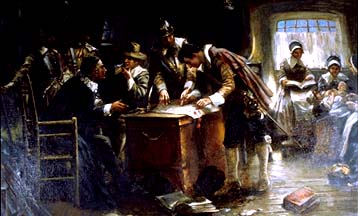
The Mayflower Compact: Signed November 11, 1620

Our Documents of Freedom Week started on Sunday—leading into July 4th for the big doc. This is an excellent opportunity for my kids to do a whole lot of eye-rolling and groaning about how they’re the “ONLY ONES” (very common refrain over here) who have to read 400-year-old documents.

So, here’s the first doc: The Mayflower Compact: Signed November 11, 1620
One of these years, I’m going to back up to 1215 and read the Magna Carta, but the Mayflower Compact is nice and short which helps to lower the coefficient of freakout for family reading.

File:Mayflower compact.jpg

The original document was lost, but the transcriptions in Mourt's Relation and William Bradford's journal Of Plymouth Plantation are in agreement and accepted as accurate. Bradford's hand written manuscript is kept in a special vault at the State Library of Massachusetts.[4] Bradford's transcription is as follows:

In the name of God, Amen. We whose names are underwritten, the loyal subjects of our dread Sovereign Lord King James, by the Grace of God of Great Britain, France and Ireland, King, Defender of the Faith, etc.Having undertaken, for the Glory of God and advancement of the Christian Faith and Honour of our King and Country, a Voyage to plant the First Colony in the Northern Parts of Virginia, do by these presents solemnly and mutually in the presence of God and one of another, Covenant and Combine ourselves together into a Civil Body Politic, for our better ordering and preservation and furtherance of the ends aforesaid; and by virtue hereof to enact, constitute and frame such just and equal Laws, Ordinances, Acts, Constitutions and Offices, from time to time, as shall be thought most meet and convenient for the general good of the Colony, unto which we promise all due submission and obedience. In witness whereof we have hereunder subscribed our names at Cape Cod, the 11th of November, in the year of the reign of our Sovereign Lord King James, of England, France and Ireland the eighteenth, and of Scotland the fifty-fourth. Anno Domini 1620.[5][3]

Love that first sentence!

____________________________

Tuesday, June 1, 2010

The Stinking Dead Fish of Storytelling

Sorry, everyone. You already read this. It was my first blog post back in 2008. I was just trying to clean up the ridiculous formatting mess, and somehow I managed to re-post it. . . Now, on with your day.

I want to love opera . . . really, I do. I love the soaring arias, the rich baritone voices, grand choruses blasting me with the glory of the music—so much excellence and effort represented in every production, many lifetimes of practice and rehearsal on stage.

Beyond the music, I love the extravagant sets, the dazzling costumes! So many sensory pleasures crammed into a single event.

Are you convinced? I really want to love opera. And, I do . . . except for one tiny detail . . . the plots. Or, I should say, "the lack of plot." Opera plots stink. They are the dead fish of storytelling.

Honestly, with the amount of effort and money that went into those grand operas, couldn't anyone have thrown a few bones at a decent writer to put some story into it? Why not? Why pretend we're telling a story (sets, costumes, the fog machines for the love of Pete!), when we have to trudge through the misery of the opera plot?

Opera-lovers will call me a Philistine. How pedestrian to need a plot—and obtuse! But, please look with fresh eyes at one of the greatest—the very best that the opera world produced: Verdi's Aida.

(Sorry, Wagner will not even get an honorable mention here—nothing for the man who sweats syrup.)

I just saw a delightful production last week done by Utah Festival Opera. The performance was impeccable: brilliant soloists, huge choruses, exquisite sets—three intermissions! But, the excellent production couldn't overcome the congenital problem—the defect of birth—no plot! Nothing happens on stage--literally. The opera goes (roughly) like this:

  • Collection of people on stage singing: La, Laaa. Something happened before the curtain came up, there was a battle, we are patriotic. Egypt is great. Aida fell in love. Things happened, but you missed it, because it all happened before this opera began. Ahaaaaaaaa!
  • Re-arrange the same collection of people: Aaah, aaaah. I love Radames, but I long for my homeland. I'll never be happy.
  • Turn set upside down for different look. Add another group of people (same guys, different costumes)—still everyone standing around doing nothing: Hark! Ethopian slaves! Aida's father is one of them. We're very sad. We long for our homeland.
  • Re-arrange again: There was another battle. You missed it because it happened during intermission, but Radamses won again. BIG, AMAZING CHORUS—sounds like the end. . . (psych!)
  • Out of love for Aida, Radamses accidentally reveals plans for the next battle. (Okay, I concede something did happen here.)
    He's condemned (offstage again) to die for his treason by being buried alive in a tomb. Oooohh, Oh!
  • Aida sneaks into the tomb so they can die there together. Biggest opera of all time ends with the dying stars singing a diminishing duet. (No way is this the end!)

I left out all the meandering with the extraneous love interest that comes to nothing. (Gotta have something for the mezzo.)

You call that a story? I'm telling you, the opera emperor is naked, and we continue to shell out $50 a ticket (I sit in the cheap seats) for NO PLOT!

An Idea

I propose a solution to the stinking opera plot. (If I ever come into great sums of money, I will oversee this myself.) We need to rehabilitate the grand operas. Pay some seriously good writers to take the brilliant music of the masters and give us a good story already! So when it's over, we're truly satisfied—catharsis. Our bearings are reset, and we're ready to step back into life, revitalized, ready to live and love.

Is that too much to ask?

With the glorious music, it should be a cinch. Take, for example, La Boheme, the most pathetic of them all, where the brilliant-music-to-crappy-plot ratio soars the highest, and the characters are so pathetic, you can't care about them at all. (Please . . . stay with me here . . . )

Mimi the seamstress is "co-habitating" with Rudolfo the poet and his student friends. They're all poor—too poor, in fact, for Rudolpho to pay for medical care when Mimi contracts the dreaded consumption. She coughs and coughs and Rudolfo sings that he can't stand to be with her anymore—her coughing drives him crazy and reminds him that he can't provide for her. (What a guy!) They agree to split up in the spring. (This is supposed to be romantic somehow. Go figure.) Mimi moves in with a viscount, but leaves him too (What a girl!) and wanders the streets until Rudolfo hears that she's homeless. He takes her back just in time for them to sing a glorious duet before she dies. (How noble!) The opera ends and we pretend that those people were worth all that breath. (Did you hear the thud?)

Imagine, now that Stephenie Meyer gets her hands on Puccini's music, and instead of the wimpy, Rudolpho, whining about Mimi's illness, we have the noble, self-sacrificing Edward, in all his luxurious restraint, coming to the rescue. Think of the tension that would snap into those soprano-tenor duets if they included Edward's thirst for Bella's blood, his longing for her scent and the tremor of her heartbeat. Instead of the village scenes, the school and Phoenix airport. Instead of the courtyard, the forest. Appealing, isn't it?

I know this would work.

Imagine that Orson Scott Card put Ender's Shadow into The Magic Flute! Honestly, I have no idea how that would work, but I'm confident that OSC could pull it off beautifully, and I'll bet he could do it without the misogyny.

Give Tosca to Frank McCourt, Turandot to Jeannette Walls, and to lighten it up, we could beg the great one, JK Rowling, to re-do Faustus. And to be sure we've covered the whole spectrum, let Dave Barry re-write Gianni Schicchi—oh the humanity!

The writer in me screams for justice, but like any addict, I'll continue to feed on a drug I can't afford because I can't stay away from the music—I love it too much!

Thursday, May 27, 2010

Theological Landmines . . . or . . . Questions I Hadn't Anticipated

"How come we all get to get resurrected but not babies in tummies?"

Yes, I got that question today. Eden was serious and I had no answer.

It snuck up on me. She started with, "When will your baby get resurrected?"
"Well, I don't think she gets resurrected. . . . I mean, she wasn't all the way a baby. I think. But, I did see her arms and legs moving. . .  I have no idea."

And, then I can see that "no fair" look on her face, and she slams me with, "How come we all get to get resurrected but not babies in tummies?" Ahhh, the old familiar slap of theological ambivalence. (It cracks me up when I hear non-believers accuse religious people of being "so black and white." I wish!)

I swear children are born understanding the concept of resurrection. Nothing makes more sense to them than the notion that whatever/whoever has died will one day wake up and be alive again. What they can't understand is why it's taking so long.

Nancy was only four when I heard her tell a cousin, "When Grandma Nonie gets resurrected, we're going to get a dog." A long string of very rational, inductive reasoning brought her to this verity (I'll fill in another time), but what matters is, I could tell by her tone of voice that this event was absolutely secure and just around the corner in her mind.

So, I should not have been surprised that Eden wanted to nail down exactly how this resurrection business would work for our family now.

After a couple of false starts at answering, I had to end with, "We just don't know--would you like a taco?"

(I'm a coward.)

Friday, May 21, 2010

"I have chemo tomorrow. Let me know if there is anything I can do to help you."

Seriously, I got an email from a friend with those exact words. And she meant it.

After three weeks of bed rest and much jubilation that I had finally stopped bleeding, I found out on Tuesday that my baby (12 weeks) no longer had a heart beat.

The pregnancy was tenuous, so it hadn't made facebook yet, but my heart had already shifted from "MOE" (mother of eight) to "MON" (mother of nine). And the kids' had done the same.

I have my few baby girl clothes in the baby slot in my closet. (Just what's left from a box that got lost and never used. Everything else I gave away.) I need to put those somewhere. And put the Pack n Play deep in the fruit room. And, the double stroller. . .

I need to adjust my plans. No baby November 30th. (David could have registered to teach at AutoDesk University that week.) No redo of the family nativity picture with a new baby. A thousand very small, almost imperceptible adjustments--together they make a wave that rolls over me and back again, an invisible tide.

As a counterwave, I have my life: too many children (read: interruptions) to keep up grief for more than a minute or two.  I also have my gift for procrastination that even reaches into grieving: just like laundry, I can actually put off my grief until I'm "in the mood" to be sad. I've been doing that fabulously while I've waited for the miscarriage to start.

I decided to lay my anxiety to rest and finally had a D&C this morning. I'm relieved. And sad. It's over. She's really gone.

On my way to bed, I ruminate on how much sadness I'll allow myself to feel when I lie down. And, then my last look at email . . . and there's that line: "I have chemo tomorrow. Let me know if there is anything I can do to help you." Oh, the blessed irony of it! It's part of a very sweet note of consolation from someone who really has reasons to complain. And, because I know the life she leads, I know she means it. She threw in the chemo comment just to explain that she'd be tied up in the morning. And, suddenly, I'm laughing and crying. . . and thinking . . .

 . . . maybe I can blog about this after all.

Thank you, Deanne, and all my D6 friends and ResponsibleWomen, and family for the many comforting words dinners and banana breads, watching my kids during the bed rest even though it came to nothing. You're all part of my counterwave, the sine for the cosine of my grief.

Friendship is a rich and priceless gift . . . a kind of baby. I feel wealthy!

Thank you!

(Davie, please notice: I used a math metaphor there. I'd like credit for that. Thanks.)

Wednesday, May 12, 2010

My Girls' Lax

We had a great game yesterday. The girls played hard. 

Fun write up here

Opening lines were my favorite: 
"Junior attack Nancy Linford registered a game-high five points on four goals and one assist to lead No. 17 Alta to a 17-2 victory over Park City in a Utah Lacrosse Association Division I semifinal Tuesday night at Juan Diego Catholic High School. . .
The Hawks have outscored their opponents, 269-46.
Tuesday’s game was more of the same for a team that is playing a different level than the rest of the state." 
State game on Saturday in Bountiful. 

Thursday, April 22, 2010

Something for Earth Day: My Rainforest


Hi friends, this post (marriage: my rainforest) has been reposted here: 

I have to take it off my blog, so it won't impact the other site's search results for being repeat content. I've just left the ending here, since they didn't take it with the rest of the essay. 

Ciao!
Sally

Please, keep talking . . . "Who overcomes by force, hath overcome but half his foe" (Milton)

Monday, April 12, 2010

My Best Lesson Yet!


Bondage, Passover, and Exodus

That was the title of today's lesson. . . . Oh, haven't mentioned, I teach Gospel Doctrine? . . .That's because I just barely admitted it to myself (even after 6 months).

It's my bi-weekly heart attack . . . and the closest I have ever come to saying no to a calling. (fyi: in my family, saying no to a calling is roughly the equivalent of  . . . oh, I don't know what--but something awful--truly awful. And, I'm nobly passing on this fine tradition to my own children.)


Today was my best lesson ever!

I've been dreading it because it covers so much and it's so important--basically, everything between the death of Joseph and the Exodus out of Egypt--no sweat. 
Moses' miraculous rescue, his childhood as a prince of Egypt, going out to look at "his" people, defending the slave, killing the Egyptian, escape into Midian, life with Reuel/Jethro and Zipporah, children born, meeting with God, burning bush, prophetic calling, rejection by the Pharaoh and the Israelites (he had the toughest job! even worse than Gospel Doctrine teacher), 10 plagues, institution of Passover (don't forget to tie it into the Last Supper and institution of the Sacrament), gather spoils of Egypt, prep to leave, the big exit, Pillar of Fire / Cloud, walk through the Red Sea. Egypt decimated, Israel free.  
I left Sacrament Meeting during the closing hymn to set up my awesome powerpoint. Went for a quick hair check, and coming back into the room, I heard the most magical words: "I thought I had the lesson?" 

Yes! She did. I blew it. Joy! Peace! Love! (Finally, a weakness becomes a strength--calendar problems.)
I absolutely insisted that my fine partner proceed with her lesson. It was delightful. I was totally prepared and didn't have to go through with it--the greatest of all possibilities. 

I love my calling! 


Can someone please explain the freaky formatting issues in blogger? This is getting ridiculous.